Children naturally ask questions.
Why does this work? How can I build this? What happens if I change it?
These simple questions are the beginning of problem-solving.
Toys are not only sources of entertainment. The right toys can give children opportunities to think, experiment, make decisions, and discover solutions on their own.
What Is Problem-Solving?
Problem-solving is the ability to understand a challenge, think about possible solutions, try one, learn from the result, and try again.
Children develop these skills gradually through everyday experiences and play.
How Do Toys Encourage Problem-Solving?
1. They Encourage Trial and Error
Building toys often don't work perfectly on the first attempt.
A child may build something, see it fall apart, and try again.
That simple process teaches an important lesson:
Mistakes are part of learning.
2. They Encourage Logical Thinking
Puzzles, construction sets, matching games, and strategy games require children to think about what should happen next.
This develops their ability to connect actions with results.
3. They Build Patience
Some activities take time.
When children work toward completing a model or solving a puzzle, they practise staying focused even when the answer isn't immediate.
4. They Encourage Creativity
Open-ended toys don't have only one solution.
Children can create different models, designs, and structures.
This allows them to think beyond a fixed answer.
5. They Improve Decision-Making
When building or playing a game, children constantly make small decisions.
Which piece should I use? Where should it go? What should I try next?
These decisions help develop independent thinking.
Best Types of Toys for Problem-Solving
Building Toys
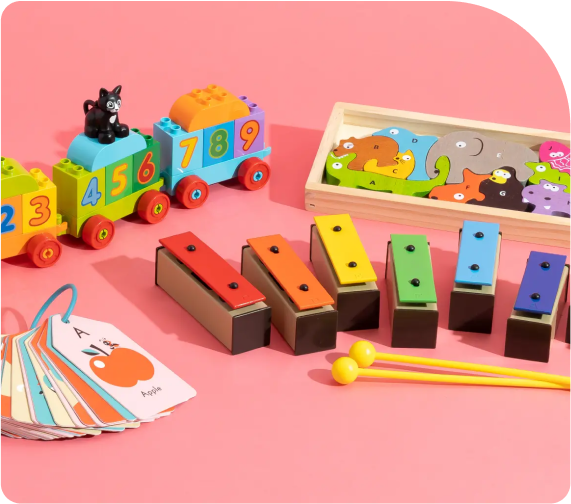
Building sets allow children to create structures and experiment with different designs.
Puzzles
Puzzles encourage children to identify patterns, shapes, and relationships.
STEM Toys
STEM toys combine hands-on play with concepts related to science, technology, engineering, and mathematics.
Construction Toys
Construction toys allow children to connect different components and understand how parts work together.
Strategy Games
Age-appropriate strategy games encourage planning and decision-making.
How Parents Can Encourage Problem-Solving
Parents don't always need to give children the answer.
Instead of saying:
“Put this piece here.”
Try asking:
“Where do you think this piece should go?”
Instead of fixing something immediately, give your child some time to figure it out.
You can ask:
- What are you trying to build?
- What do you think went wrong?
- What could you try differently?
- What do you think will happen next?
These questions encourage children to think independently.
Let Children Make Mistakes
One of the most important parts of learning through play is allowing children to fail safely.
If a tower falls, a puzzle doesn't fit, or a model doesn't work, don't treat it as failure.
Treat it as another opportunity to experiment.
Play Is Learning
When children play with the right toys, they may be developing important skills without even realising it.
They are planning, testing, observing, adjusting, and trying again.
That is problem-solving in action.
Final Thoughts
A toy doesn't need to teach a lesson directly to be educational.
Sometimes the most valuable toys are the ones that make children think, create, experiment, and try again.
Give children the freedom to explore—and you may be surprised by the solutions they discover.